
These days, artificial intelligence is one of the topics that every company wants to discuss.
Every business, including technology, e-commerce, banking, and healthcare, is attempting to determine how AI will fit into its future. Businesses are boldly integrating chatbots into their websites, automating customer service, and developing "smart" features that promise quicker and more customised experiences.
To be honest, it makes sense.
AI appears impressive. It seems like an advancement. It conveys the idea that a company is cutting-edge, inventive, and modern.
However, most businesses are unaware of this until it's too late: They're not getting off to a good start.
They are concentrating on what customers can see rather than addressing internal company issues. They are prioritizing customer-facing AI over internal operational improvements.
And that's precisely where things start to go wrong.
 Why Most Businesses Get AI Adoption Wrong
Let's be honest: customer-facing AI is appealing. It's easy to justify. It's easy to demonstrate. Most significantly, it is easy to sell.
When a company introduces a chatbot or an AI assistant, it immediately gives the idea that the business is evolving. It seems like a step forward.
That's why many businesses start with:
AI chatbots for customer care.
Automated email replies
Recommender engines
AI-generated content.
These elements are noticeable, engaging, and measurable.
But here is the issue: They do not address the actual issues within the business.
If your internal processes are inefficient, adding AI to the front end will not address the problem. It just overlays a smarter interface on top of a flawed system.
And, sooner or later, the divide becomes evident.
The Hidden Gap Between Experience and Reality
When AI is used only on the front end, organisations create a disconnect. Customers have an experience that is both modern and speedy. However, internal teams continue to struggle.
You'll frequently encounter circumstances like:
A chatbot responds quickly, but the issue still takes days to address.
AI recommendations exist, but they rely on inadequate data.
Automated responses sound smart, but they lack true context.
This happens because AI is only as good as the system that powers it.
If your workflows are inefficient, AI will reflect that. If your data is unorganised, AI will deliver unreliable results. If your processes are slow, AI will not miraculously accelerate them.
Instead of fixing issues, AI is revealing them.
Why Internal Operations Should Come First
If organisations want AI actually to add value, the focus must shift. Instead of asking, "How can we use AI to impress our customers?"
The actual question should be: "How can AI make our business work better?"
Because this is where the true transformation occurs.
AI performs best as an internal engine
AI is fundamentally about optimisation rather than merely interaction. It helps businesses:
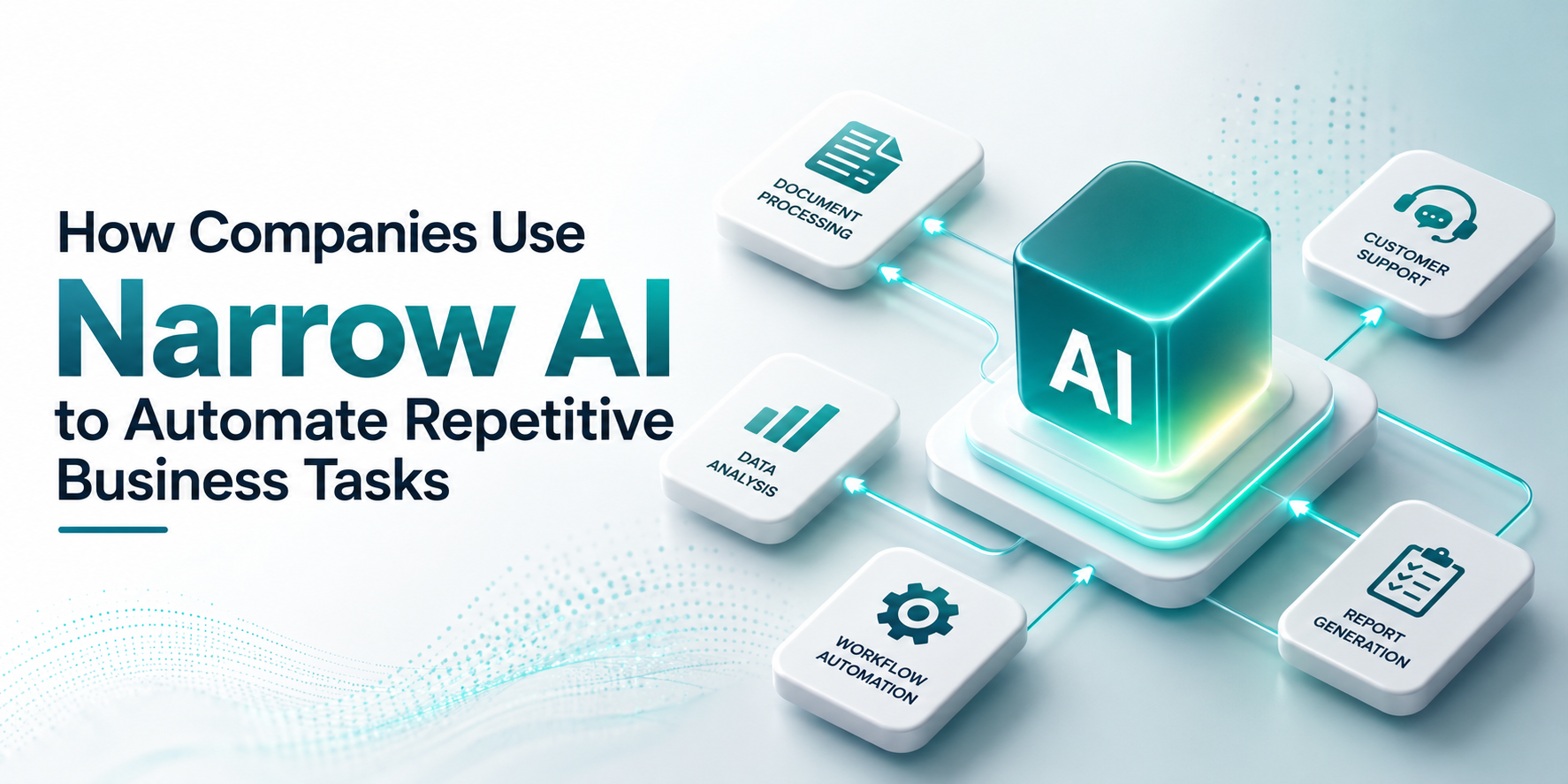
Automate the repetitive chores.
Increase workflow efficiency.
Reduce the operational costs.
Improve decision-making.
These benefits have a significantly greater influence internally than externally. When AI is applied to internal systems first, it establishes a solid foundation for everything else.
Internal AI makes a real, measurable impact.
One of the most significant benefits of starting domestically is clarity. You can actually quantify the results.
For example:
Tasks that once took hours now take minutes.
Teams can handle more work without adding manpower.
Errors decrease considerably.
Processes become faster and more predictable.
This is actual ROI, not just perceived worth.

Where AI Creates the Most Impact Inside a Business
If you’re thinking about where to begin, the answer is simple: Start where your business feels the most friction.
Customer Support (Before ChatBots)
Instead of focusing just on chatbots, consider improving internal support processes. AI is capable of: Automatically categorise tickets, Prioritise the urgent concerns, Route enquiries to the appropriate team.
Data and Reporting
Most companies today are overwhelmed with data yet lack clarity. AI is capable of: Clean and arrange the data, Identify patterns and trends, Generate insights automatically, Generate real-time reports.
Sales & Lead Management
AI can improve sales teams' efficiency by: Finding high-quality leads, Predicting conversion odds, Automating Follow-Ups.
HR and Hiring
Recruitment processes are frequently slow and repetitious. AI is capable of: Screen resumes fast, Match candidates with roles, Schedule interviews.
Operations and Workflow Automation
Here is where AI adds long-term benefit. AI is capable of: Optimise supply chains, Forecast demand, Automate workflows.
A Practical Comparison: Two Approaches to AI
Model-First vs Workflow-First
Where Generative AI Actually Fits
Generative AI is one of the most popular trends right now. However, most businesses hurry to use it externally for chatbots, content, and marketing. A better way is to begin inside.
You can use it for: Internal documentation, reporting, and team productivity, Knowledge Management. This enables teams to learn how to utilise it efficiently before introducing it to customers.
How Codezilla Approaches AI Differently
At Codezilla, the goal is not merely to create AI solutions, but also to create AI that works in real-world business scenarios. This means: Understanding workflows before proposing AI, Identifying inefficiencies before automation, Organising data before applying insight, Testing internally before deploying externally.
This approach assures that AI is more than a feature; it is a business advantage, because actual AI transformation does not occur at the interface. It occurs in the system.
A smarter way to adopt AI
If you want AI to produce genuine outcomes, the strategy should be straightforward:
Begin with internal challenges.
Use AI to address inefficiencies.
Create powerful data systems.
Internal testing and refinement.
Then go to customer-facing features.
This is how you go from experimenting to genuine effect.
The Bigger Shift Businesses Should Understand
AI is no longer limited to adding functionality. It is about transforming the way firms work.
We're heading toward a future in which:
Workflows are automated.
Interconnected systems support data-driven decisions.
And this transformation starts internally.
The Bottom Line
AI is strong, but only when used appropriately. If you focus solely on customer-facing features, you may generate short-term excitement but long-term issues. Starting internally allows you to construct something much stronger. You develop systems that are efficient, scalable, and reliable, and when you eventually deliver AI to clients, it works as intended.
Because in reality: Artificial intelligence does not revolutionise enterprises from the outside in. It changes them from the inside out.
.png)