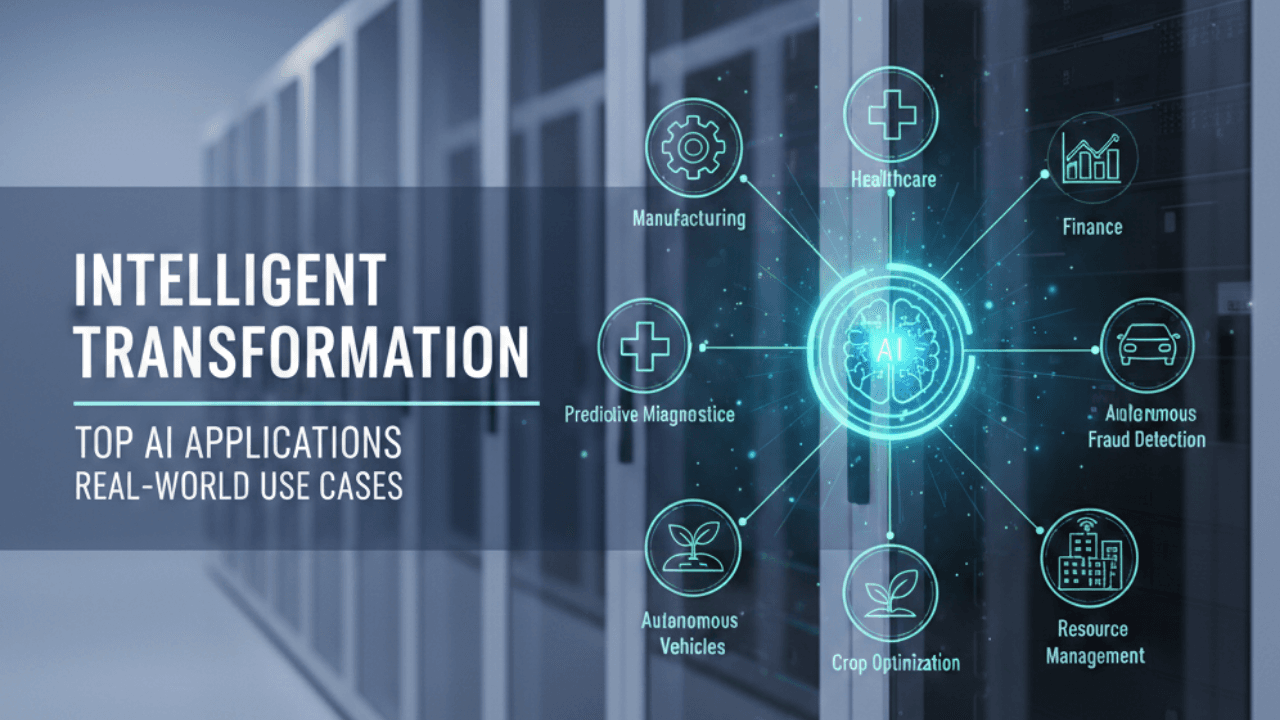

Artificial Intelligence (AI) isn’t the future of business; it's the present of transformation. From healthcare to hospitality, manufacturing to marketing, AI is reshaping how organizations operate, innovate, and create value. But beyond buzzwords, what does that mean in practice? What applications of AI are delivering real ROI? And how are industries adopting AI at scale?
In this article, we’ll explore how AI is being used in real, practical, and impactful ways across major sectors. We’ll go beyond theory, offering concrete use cases the kind executives, teams, and innovators can relate to and apply. Whether you’re a founder, a tech leader, a professional, or just curious about where AI is making waves this blog is for you.
Chapter 1 — Understanding AI’s Role in Modern Business
Before diving into industry use cases, let’s clarify what we mean by AI applications.
What AI Really Is
At its core, AI refers to technologies that allow systems to mimic human cognition:
- Learning from data
- Recognizing patterns
- Making predictions
- Improving over time
This includes subfields such as:
- Machine learning (ML): where models improve through data
- Natural Language Processing (NLP): enabling machines to understand human language
- Computer vision: giving machines the ability to see and interpret visual information
- Robotic process automation (RPA): automating repetitive workflows
Importantly, AI isn’t a one-size-fits-all solution. Its power comes from application the way it’s implemented to solve real problems.

Chapter 2 — AI in Healthcare: From Diagnosis to Personalized Care
Healthcare is one of the most impactful areas for AI not because it automates tasks, but because it enhances human decision-making.
1. Faster and More Accurate Diagnostics
AI models trained on medical imaging (X-rays, CT scans, MRIs) are now able to assist radiologists by identifying patterns associated with diseases such as:
- Cancer
- Pneumonia
- Neurological disorders
These systems can flag suspicious areas faster and, in some cases, with comparable accuracy to humans helping clinicians focus on interpretation and treatment.
2. Personalized Treatment Plans
By analyzing patient histories, genetic information, and real-time data, AI can recommend tailored treatment regimens. Personalized medicine shifts the paradigm from standard protocols to individualized care.
Example Use Case: AI systems that evaluate cancer patient data to suggest optimized chemotherapy schedules based on probability models.
3. Operational Efficiency in Hospitals
Large hospitals process massive volumes of data daily. AI helps with:
- Scheduling resources (beds, staff)
- Optimizing medical supply chains
- Predicting patient admissions
This improves patient outcomes and reduces operational waste.
4. Predictive Health Monitoring
Wearables powered by AI can alert patients and doctors of early warning signs such as irregular heart rhythms before they become critical.
Chapter 3 — AI in Finance: Smarter Decisions and Safer Systems
Finance has always been data-driven. AI accelerates that advantage.
1. Fraud Detection and Risk Management
AI models can analyze thousands of transactions per second to spot anomalies that suggest:
- Identity theft
- Unauthorized access
- Money laundering
By learning what normal behavior looks like, AI quickly isolates the unusual.
2. Algorithmic Trading
AI algorithms can react faster than human traders executing trades based on market signals, sentiment data, and historical trends. This doesn’t replace human strategy, but augments it allowing firms to operate at microsecond speed while humans guide high-level strategy.
3. Personalized Financial Advice
Chatbots and AI advisors can provide tailored investment recommendations democratizing financial guidance for everyday users.
Example: AI assistants that analyze spending patterns to help users optimize savings.
4. Credit Scoring and Risk Assessment
Traditional credit scoring relies on limited variables. AI can incorporate nontraditional data sources such as behavior patterns to offer more inclusive and accurate credit profiles.
Chapter 4 — AI in Manufacturing: Smart Factories and Predictive Systems
Manufacturing is being transformed by AI’s ability to optimize both physical and digital processes.
1. Predictive Maintenance
Instead of waiting for machines to fail, manufacturers use AI to predict when equipment will need servicing based on sensor data, usage patterns, and environmental factors.
Benefits:
- Reduced downtime
- Lower maintenance costs
- Increased lifecycle of machines
2. Quality Inspection
Computer vision systems can inspect products for defects faster and more consistently than humans, identifying even subtle imperfections.
This improves:
- Yield rates
- Customer satisfaction
- Compliance with quality standards
3. Intelligent Supply Chains
AI enhances forecasting accuracy, enabling companies to better predict:
- Demand trends
- Inventory needs
- Supplier disruptions
By optimizing logistics, manufacturers reduce waste and improve agility.
4. Autonomous Robotics
Robots equipped with AI are now collaborating with humans performing complex tasks such as:
- Sorting goods
- Packing
- Material handling
This increases throughput and boosts worker safety.
Chapter 5 — AI in Retail: Smarter Sales and Seamless Experiences
In retail, customer expectations are rising, and AI helps brands keep up.
1. Personalized Shopping Experiences
AI analyzes purchase history, browsing behaviors, and demographic trends to offer:
- Customized recommendations
- Targeted promotions
- Dynamic pricing
These enhancements boost conversions and loyalty.
2. Demand Forecasting
AI models predict what products will sell, when, and where helping retailers manage inventory and reduce overstock or stockouts. This improves profitability and optimizes inventory turnover.
3. AI-Powered Visual Search
Consumers can upload images or screenshots, and AI systems find similar products improving discoverability and engagement.
4. Chatbots & Virtual Assistants
Retail AI assistants handle:
- Customer queries
- Purchase tracking
- Return or exchange information
This creates a seamless 24/7 customer experience.

Chapter 6 — AI in Transportation & Logistics: Smarter Mobility
Transportation and logistics are ripe for disruption and AI is at the center of it.
1. Route Optimization
AI systems analyze:
- Traffic conditions
- Weather data
- Delivery schedules
…and generate efficient routing plans that reduce fuel costs and delivery times.
2. Autonomous Vehicles
AI drives advancements in self-driving cars, trucks, and drones, reimagining delivery and mobility. While fully autonomous transport isn’t universal yet, semi-autonomous systems are already improving:
- Safety
- Efficiency
- Traffic flow
3. Predictive Fleet Maintenance
Similar to manufacturing, AI monitors vehicle health preventing breakdowns before they occur. This increases uptime and reduces operating costs.
4. Inventory & Warehouse Automation
Smart warehouses use AI to:
- Track goods
- Predict demand
- Dispatch orders
- Coordinate robots
This speeds up logistics operations while reducing errors.
Chapter 7 — AI in Telecom: Intelligent Networks and Enhanced Services
Telecommunications companies are leveraging AI to support both backend networks and customer-facing experiences.
1. Network Optimization
AI continuously analyzes traffic patterns to optimize network performance, reducing congestion and improving uptime.
Example Use Case: Telecom providers dynamically allocate bandwidth during peak usage using AI predictive models.
2. Customer Service Automation
AI chatbots resolve common queries, route complex issues to human agents, and speed up support resolution times, improving customer satisfaction.
3. Fraud Prevention
AI systems detect unusual calling patterns and unauthorized access, protecting both consumers and network integrity.
4. Personalized Plans and Offers
By analyzing customer usage, AI can suggest personalized plan upgrade,s enhancing retention.
Chapter 8 — AI in Education: Personalized Learning and Intelligent Insights
AI isn’t just in labs and boardrooms; it's reshaping how people learn.
1. Adaptive Learning Platforms
AI systems analyze student progress, strengths, and weaknesses to adapt curriculum, delivering personalized learning paths.
This improves:
- Engagement
- Knowledge retention
- Learning outcomes
2. Intelligent Tutoring Assistance
AI chatbots provide help, feedback, and explanations, supplementing human instruction.
3. Administrative Automation
Tasks like scheduling, admissions processing, and resource management are now automated, freeing educators to focus on teaching.
4. Analytics for Student Success
Institutions can analyze data trends to predict dropout risks, identify learning gaps, and design targeted interventions.
Chapter 9 — AI in Energy: Optimizing Resources and Revolutionizing Grids
Energy systems are growing smarter, and AI is helping utilities operate with precision.
1. Smart Grid Management
AI helps energy providers predict demand and balance load distribution, reducing outages and improving efficiency.
2. Renewable Energy Forecasting
Solar and wind output depend on weather conditions. AI models forecast generation patterns, enabling grids to adapt.
3. Energy Consumption Optimization
AI systems analyze usage to help consumers and businesses reduce waste and optimize billing.
4. Predictive Maintenance for Infrastructure
AI detects early signs of equipment failure in:
- Turbines
- Transformers
- Pipelines
This enhances reliability and lowers repair costs.
Chapter 10 — Challenges and Considerations When Adopting AI
While AI offers transformative potential, organizations face real challenges behind the success stories.
1. Data Quality and Availability
AI depends on high-quality data. Poor, inconsistent, or biased data leads to inaccurate outcomes.
2. Ethical and Responsible AI
AI systems must be transparent, fair, and aligned with organizational values. Ethical AI governance is now a board-level responsibility.
3. Talent Gaps
Implementing AI requires expertise in:
- Data science
- ML engineering
- Systems architecture
- Domain knowledge
Bridging these gaps takes investment in hiring and upskilling.
4. Integration with Legacy Systems
Many organizations juggle legacy infrastructure, and integrating AI smoothly without disrupting operations is complex.
5. Security and Privacy
AI systems introduce new risk vectors requiring robust safeguards to protect data and users.
Chapter 11 — The Future of AI in Industry
If there’s one overarching trend across sectors, it’s this: AI is about augmentation, not replacement.
- AI amplifies human capabilities
- AI accelerates decision-making
- AI enables personalization at scale
- AI democratizes insights once reserved for large enterprises
By 2030 and beyond, AI won’t just reside in labs or R&D centers; it will be embedded into every aspect of enterprise operations.
Conclusion: Real AI - Real Impact
Artificial Intelligence is not a futuristic concept; it's the engine of modern transformation. Across industries, AI is no longer just an accelerator; it’s a strategic imperative driving:
- Better patient outcomes in healthcare
- Safer and more efficient financial systems
- Higher-quality manufacturing
- Personalized retail experiences
- Intelligent logistics
- Smarter education
- Resilient energy infrastructure
- Enhanced telecom services
Yet success doesn’t come from using AI for the sake of it. It comes from thoughtful implementation, ethical governance, and human-centered integration.
In every sector, AI must serve people by improving efficiency, empowering workers, and enabling smarter decisions. When approached responsibly, AI becomes not just a technology, but a trust engine, one that turns data into insight, insight into action, and action into better outcomes for organizations and societies alike.
This is the future of work. This is the future of industry. And it’s already here.